Tulipano: November 7, 2012

Post Election

There are a lot of opinions floating around today post election on facebook, twitter, newspapers, bus stops, water coolers and possibly watering holes. 

I for one like to keep my opinions to myself unless I am talking to those who I know share my views or more importantly, can discuss the issues without becoming defensive or belligerent.  I am so grateful for the right to vote, the freedom to speak, but this year have found the politics almost unbearable...on both sides.

So to calm my throbbing head I am going to focus on the many tasks at hand here at our little landscape company, ILT Vignocchi...

People might find it hard to believe that there is so much to do November 7th in the landscape industry but there is...here is my short list...

Winter containers:  We design, build and install over 50 winter green displays annually.  That doesn't include the tens of thousands of square feet of evergreen boughs we will install.  Each winter green display is unique in its design.  It takes seven of us five days to complete them so they are ready to be installed the week of Thanksgiving.  The best part...it smells like Christmas in the shop!

Bulbs:  Getting tulip, daffodil, and other spring blooming bulbs installed prior to the ground freezing is a a chore in itself.  Most of our seasonal staff is ready to hang up their shovels by Thanksgiving (and who can blame them)!  This year we will go from Winter container and bough installation right into getting bulbs in the ground.  Each year I think to myself, "why didn't I think to wear just ONE more layer of clothing.  It is so cold out here!"

Snow removal:  It always amazes me that one day our trucks have no plows on them and seemingly the next...shizam!  They all have plows.  Most of it can be attributed to our wonderful shop manager Ricardo and his assistant Brian.  We are so blessed to have these guys.  We also maintain a 500 acre office park plus several other HOA's.  The planning and coordination of these efforts is paramount in making certain everything runs smoothly when snow starts falling.

As I said, this is my short list.  And the list has many contributors that make it a shared responsibility...but I'll leave that for my Thanksgiving blog!!

Labels: , , , , , , , , , , , , ,

Tulipano: October 22, 2012

Overwintering herbs


Choose a sunny, south-facing window to overwinter your herbs so they get the most light in winter.
There's nothing like the taste of fresh herbs in cooking. However, in most parts of the country, fall means the herb harvest is coming to an end. If you live in a mild winter area, you can enjoy harvesting perennial herbs that naturally overwinter outdoors, such as rosemary, lavender, oregano, and thyme, as you need them all winter long. However, in most parts of the country, perennial and biennial herbs either lose their leaves in winter or just aren't hardy enough to survive at all.
You certainly can dry and freeze herb leaves for winter use, but if you crave the taste of fresh herbs in winter, bring some of these perennial herb plants indoors. Whether they were growing outdoors in the garden or in pots, you can extend the fresh herb picking season by months by bringing the plants in when frost threatens. This technique works best for perennial and biennial herbs, such as chives, mint, oregano, thyme, parsley, and rosemary. Annual herbs, such as basil, tend to tire after a few weeks indoors. Annual herbs are best started from seed indoors under grow lights and grown as new plants for a winter harvest.
Here are the steps to bringing your perennial herb garden indoors.
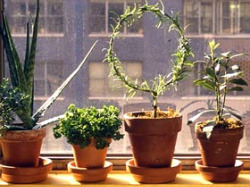
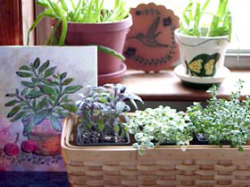
Who says overwintering herbs can't be displayed in an attractive fashion?
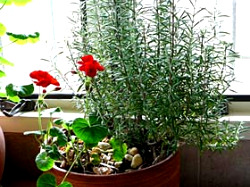
Rosemary can be overwintered indoors if given plenty of humidity and light.
  1. Select the healthiest herb plants in the garden. Don't necessarily select the largest plants. The digging and transplanting process will destroy many roots. Small to medium-sized plants will survive better.
  2. Check plants for any signs of insect activity and spray accordingly with an organic product, such as insecticidal soap, before moving them indoors.
  3. Water plants well and dig up herb plants in the garden on a cool, cloudy day. Place them in an appropriately-sized pot.
  4. Place these newly transplanted herb plants in a shady spot to adjust to the transplanting for 1 to 2 weeks. Keep them protected from winds and cold temperatures.
  5. Move container herbs that have been growing in full sun outdoors all summer into the shade at the same time. The lower indoor light conditions will be a shock to most plants, so acclimate them to the indoor environment by growing them in the shade outdoors for a few weeks.
  6. Before a frost, bring all the herb plants indoors and place them in a sunny, south-facing window.
  7. Check for any insects that have hitched a ride indoors on your plants.
  8. Water sparingly and don't fertilize.
  9. Most herbs will grow slowly, or not at all, indoors in winter. Harvest what you need, but leave some leaves for the plant to survive. You'll see your plants rebound come late winter when the stronger light levels and longer days return. The exception is parsley. This biennial herb will survive the winter only to send up a flower stalk in spring and then die. Pick all the parsley you want and compost the plant when you're done.
  10. Rosemary has special needs to survive. It likes cool temperatures (50- to 60-degree F), high humidity, and barely moist soil in winter. Keep the humidity high by misting often, and place the pot on a pebble tray filled with water. Water the pot just enough to keep the soil from drying out.
  11. Come spring, once all danger of frost has passed, move your perennial herb plants back outside. Repot them into pots with fresh potting soil, or transplant them into the garden. They will bounce back and start putting on new growth in no time.

Labels: , , , , , , , ,

Tulipano: October 8, 2012

How to chase the winter blues out of your garden

It is all too often the case that landscape and garden designers, out of a zealousness for flowers, overlook the beauty that can be carried through winter by selecting certain shrubs and perennials with long lasting pizazz.

Here are some of my favorites.

Colored-twig dogwoods (Cornus sericea) are also a fantastic choice for winter color. When they lose their leaves, they reveal bright red, yellow, or orange stems that show off well against a backdrop of dormant grasses or evergreen shrubs. And the display's not limited to outdoors, either, since the cut stems last a long time in a vase or a holiday wreath. Colored-twig dogwoods grow in full sun to part shade and reach about 4-10' tall and wide, depending on the variety.

Ornamental grasses are a great additions to a winter garden, and not only the evergreen varieties. Many grasses go dormant gracefully, leaving a fluffy mass of brown strands that look surprisingly at home among winter annuals and other color. Evergreen grasses include sedges like Carex 'Toffee Twist', variegated sweet flag (Acorus gramineus 'Variegata'), and silver spear (Astelia chathamica 'Silver Spear'), while fountain grass (Pennisetum) and dwarf varieties of maiden grass (Miscanthus) make a great show in dormancy.

Cotoneaster (Cotoneaster apiculata and 'Hessii') is a must if you have walls or walkways it can crawl upon.  The berries over the winter months add a little holiday spirit.

I find that homeowners are reluctant when we want to leave Annabelle Hydrangea up over the winter, but it looks so much better than an empty bed.  And the older the species, the more blooms and stalks, the better the winter show.

Labels: , , , ,

Tulipano: August 21, 2012

Fun interesting tips for homeowners

1. To remove the salt deposits that form on clay pots, combine equal parts white vinegar, rubbing alcohol and water in a spray bottle. Apply the mixture to the pot and scrub with a plastic brush. Let the pot dry before you plant anything in it.

2. To prevent accumulating dirt under your fingernails while you work in the garden, draw your fingernails across a bar of soap and you'll effectively seal the undersides of your nails so dirt can't collect beneath them. Then, after you've finished in the garden, use a nailbrush to remove the soap and your nails will be clean.

3. To prevent the line on your string trimmer from jamming or breaking, treat with a spray vegetable oil before installing it in the trimmer.

4. Turn a long-handled tool into a measuring stick! Lay a long-handled garden tool on the ground, and next to it place a tape measure. Using a permanent marker, write inch and foot marks on the handle. When you need to space plants a certain distance apart (from just an inch to several feet) you'll already have a measuring device in your hand.

5. To have garden twine handy when you need it, just stick a ball of twine in a small clay pot, pull the end of the twine through the drainage hole, and set the pot upside down in the garden. Do that, and you'll never go looking for twine again.

6. Little clay pots make great cloches for protecting young plants from sudden, overnight frosts and freezes.

7. To turn a clay pot into a hose guide, just stab a roughly one-foot length of steel reinforcing bar into the ground at the corner of a bed and slip two clay pots over it: one facing down, the other facing up. The guides will prevent damage to your plants as you drag the hose along the bed.

8. To create perfectly natural markers, write the names of plants (using a permanent marker) on the flat faces of stones of various sizes and place them at or near the base of your plants.

9. Got aphids? You can control them with a strong blast of water from the hose or with insecticidal soap. But here's another suggestion, one that's a lot more fun; get some tape! Wrap a wide strip of tape around your hand, sticky side out, and pat the leaves of plants infested with aphids. Concentrate on the undersides of leaves, because that's where the little buggers like to hide.

10. The next time you boil or steam vegetables, don't pour the water down the drain, use it to water potted patio plants, and you'll be amazed at how the plants respond to the "vegetable soup."
 11. Use leftover tea and coffee grounds to acidify the soil of acid-loving plants such as azaleas, rhododendrons, camellias, gardenias and even blueberries. A light sprinkling of about one-quarter of an inch applied once a month will keep the pH of the soil on the acidic side.
12. Use chamomile tea to control damping-off fungus, which often attacks young seedlings quite suddenly. Just add a touch of tea to the soil around the base of seedlings once a week or use it as a foliar spray.
13. If you need an instant table for cocktails, look no farther than your collection of clay pots and saucers. Just flip a good-sized pot over, and top it off with a large saucer.
 14. The quickest way in the world to dry herbs: just lay a sheet of newspaper on the seat of your car, arrange the herbs in a single layer, then roll up the windows and close the doors. Crazy sounding, but it works!

Labels: , , , , , , , ,

Tulipano: April 24, 2012

When to plant, really.

You know every spring I hear myself telling my customers, "I've never seen so much rain!" or "they are predicting snow" or pick a springtime woe for your landscape and we've had it.

This year I can honestly say that we have never experienced a spring like this one.  Some major stand out moments:

- I have tulips in raised beds that did not bloom because the temperature of the soil did not fall below the recommended 62 degrees F for a long period of time.

- We began mowing grass, because it needed it, 4-5 weeks early.

- I have seen grub activity (or animals feeding on grubs) as early as the first week in April.

- Our wholesale nursery started releasing material as ready to plant in March, which is 3 weeks early.

Because this winter and spring has been so unpredictable, I offer a cautionary word to those who are thinking about planting annuals, herbs and vegetables sooner than later.  Normally our last day of frost does not go past May 15th.  I would stick to that date.  With conditions precarious at best, it seems best to wait.

If you are excited and anxious what you can do instead is try starting seeds inside.  It can be done in something as inexpensive as an egg carton!  You can start some vegetables as well as some annuals, and this activity is great for teaching children about biology on a small accessible level.  Just remember to wait until after May 15th to bring them outside.

My favorites to start from seed:

Vegetables
Zucchini
Squash
Cucumbers
All herbs

Annual flowers
Zinnia
Alyssum
Cosmos
Marigolds

Check out this great article on growing annuals from seeds:
http://www.gardeners.com/Growing-Annual-Flowers-from-Seed/5663,default,pg.html 

Labels: , , , , , , , ,