Tulipano: March 4, 2014

Dreaming of Spring

As I sit at my desk looking out on a snowy wonderland, sun dancing off icicles still clutching to our gutter, I wonder what spring will bring.

You see I am one of those people that covet winter.  I love how quiet and graceful snow makes everything seem.  I relish that the world feels more peaceful and still. 

This winter has been long and cold and even in my household we are getting tired of clearing off yet another snowfall from our drive and walks.

Although I love the serenity winter brings I am now dreaming of crocus, thawing lakes and streams, and even what varieties of vegetables will grace my little garden.  I am looking forward to a display of spring bulbs which should do nicely given the insulation of their cozy snow blanket.  My husband is ready to break out the smoker and start up the grill. And my poor child told me yesterday, "mommy, I know you love winter, but I don't.  I am ready for it to be warm."

This winter has been record breaking and truly epic in nature and yes, it is time for it to pass, but am curious to see what this winter's legacy will be come spring.  

Labels: , , , , , , ,

Tulipano: November 7, 2012

Post Election

There are a lot of opinions floating around today post election on facebook, twitter, newspapers, bus stops, water coolers and possibly watering holes. 

I for one like to keep my opinions to myself unless I am talking to those who I know share my views or more importantly, can discuss the issues without becoming defensive or belligerent.  I am so grateful for the right to vote, the freedom to speak, but this year have found the politics almost unbearable...on both sides.

So to calm my throbbing head I am going to focus on the many tasks at hand here at our little landscape company, ILT Vignocchi...

People might find it hard to believe that there is so much to do November 7th in the landscape industry but there is...here is my short list...

Winter containers:  We design, build and install over 50 winter green displays annually.  That doesn't include the tens of thousands of square feet of evergreen boughs we will install.  Each winter green display is unique in its design.  It takes seven of us five days to complete them so they are ready to be installed the week of Thanksgiving.  The best part...it smells like Christmas in the shop!

Bulbs:  Getting tulip, daffodil, and other spring blooming bulbs installed prior to the ground freezing is a a chore in itself.  Most of our seasonal staff is ready to hang up their shovels by Thanksgiving (and who can blame them)!  This year we will go from Winter container and bough installation right into getting bulbs in the ground.  Each year I think to myself, "why didn't I think to wear just ONE more layer of clothing.  It is so cold out here!"

Snow removal:  It always amazes me that one day our trucks have no plows on them and seemingly the next...shizam!  They all have plows.  Most of it can be attributed to our wonderful shop manager Ricardo and his assistant Brian.  We are so blessed to have these guys.  We also maintain a 500 acre office park plus several other HOA's.  The planning and coordination of these efforts is paramount in making certain everything runs smoothly when snow starts falling.

As I said, this is my short list.  And the list has many contributors that make it a shared responsibility...but I'll leave that for my Thanksgiving blog!!

Labels: , , , , , , , , , , , , ,

Tulipano: October 22, 2012

Overwintering herbs


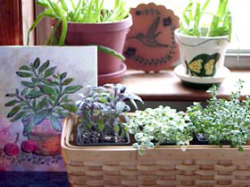
Choose a sunny, south-facing window to overwinter your herbs so they get the most light in winter.
There's nothing like the taste of fresh herbs in cooking. However, in most parts of the country, fall means the herb harvest is coming to an end. If you live in a mild winter area, you can enjoy harvesting perennial herbs that naturally overwinter outdoors, such as rosemary, lavender, oregano, and thyme, as you need them all winter long. However, in most parts of the country, perennial and biennial herbs either lose their leaves in winter or just aren't hardy enough to survive at all.
You certainly can dry and freeze herb leaves for winter use, but if you crave the taste of fresh herbs in winter, bring some of these perennial herb plants indoors. Whether they were growing outdoors in the garden or in pots, you can extend the fresh herb picking season by months by bringing the plants in when frost threatens. This technique works best for perennial and biennial herbs, such as chives, mint, oregano, thyme, parsley, and rosemary. Annual herbs, such as basil, tend to tire after a few weeks indoors. Annual herbs are best started from seed indoors under grow lights and grown as new plants for a winter harvest.
Here are the steps to bringing your perennial herb garden indoors.
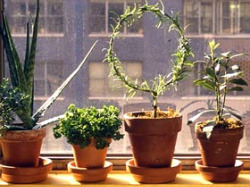
Who says overwintering herbs can't be displayed in an attractive fashion?
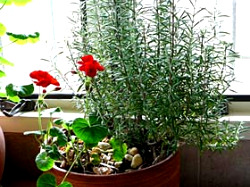
Rosemary can be overwintered indoors if given plenty of humidity and light.
  1. Select the healthiest herb plants in the garden. Don't necessarily select the largest plants. The digging and transplanting process will destroy many roots. Small to medium-sized plants will survive better.
  2. Check plants for any signs of insect activity and spray accordingly with an organic product, such as insecticidal soap, before moving them indoors.
  3. Water plants well and dig up herb plants in the garden on a cool, cloudy day. Place them in an appropriately-sized pot.
  4. Place these newly transplanted herb plants in a shady spot to adjust to the transplanting for 1 to 2 weeks. Keep them protected from winds and cold temperatures.
  5. Move container herbs that have been growing in full sun outdoors all summer into the shade at the same time. The lower indoor light conditions will be a shock to most plants, so acclimate them to the indoor environment by growing them in the shade outdoors for a few weeks.
  6. Before a frost, bring all the herb plants indoors and place them in a sunny, south-facing window.
  7. Check for any insects that have hitched a ride indoors on your plants.
  8. Water sparingly and don't fertilize.
  9. Most herbs will grow slowly, or not at all, indoors in winter. Harvest what you need, but leave some leaves for the plant to survive. You'll see your plants rebound come late winter when the stronger light levels and longer days return. The exception is parsley. This biennial herb will survive the winter only to send up a flower stalk in spring and then die. Pick all the parsley you want and compost the plant when you're done.
  10. Rosemary has special needs to survive. It likes cool temperatures (50- to 60-degree F), high humidity, and barely moist soil in winter. Keep the humidity high by misting often, and place the pot on a pebble tray filled with water. Water the pot just enough to keep the soil from drying out.
  11. Come spring, once all danger of frost has passed, move your perennial herb plants back outside. Repot them into pots with fresh potting soil, or transplant them into the garden. They will bounce back and start putting on new growth in no time.

Labels: , , , , , , , ,

Tulipano: October 17, 2012

Fun Pumpkin Facts


donna's pumpkins

pumpkins carved by Aaron and Sofia Zych

Total U.S. pumpkin production was valued at around $140 million equaling 1.1 billion lbs


496 million pounds of pumpkins were produced in Illinois.


The top pumpkin production states are Illinois, Ohio, Pennsylvania and California.


Around 90 to 95% of the processed pumpkins in the United States are grown in Illinois.


Pumpkins originated in Central America.


In early colonial times, pumpkins were used as an ingredient for the crust of pies, not the filling.


The largest pumpkin ever grown weighed 1,140 pounds.


The name pumpkin originated from "pepon" - the Greek word for "large melon."


Pumpkins are 90 percent water.


Pumpkins are a fruit.


Colonists sliced off pumpkin tops; removed seeds and filled the insides with milk, spices and honey. This was baked in hot ashes and is the origin of pumpkin pie.


Native Americans flattened strips of pumpkins, dried them and made mats.

Labels: , , , , ,

Tulipano: October 8, 2012

Top 10 Plants You Can't Kill

As gardeners, we're constantly faced with challenges: plants that won't bloom, flowers that die from a late frost, droughts that wipe out entire beds.

Gardening definitely has its fair share of difficulties, so every once in a while it's nice to have plants that require little maintenance. Even better-grow plants you can't kill!
Sure, spraying these all-stars with weed killer would probably lead to their demise. But for the most part, these are hardy, maintenance-free picks that work well in any North American backyard.

So are you ready to turn your black thumb into a green thumb? Get planting with these top picks.

coneflower

Coneflower

(Echinacea, Zones 3 to 9)
Coneflowers have become a garden staple for their easygoing nature. Growing 2 to 5 feet high and 2 feet wide, they are the perfect companion plant in just about any garden. They require well-drained soil but will thrive in full sun as well as partial shade. Known for attracting birds, bees and butterflies, coneflowers also make lovely cut blooms.

Why I love it: The coneflower is the low-maintenance star of nature-friendly gardens. It comes in many colors, and it's easy to find one you will love.

Colors: purple, pink, crimson, white, yellow, orange and even green.

cosmos

Cosmos

(Cosmos bipinnatus)
If big, beautiful flowers are one of your top requirements, cosmos is perfect for you. Though it's an annual, it often reseeds on its own. Blooming summer to frost and growing up to 6 feet high, this backyard favorite deserves a regular spot in your sunny garden.

Why I love it: It's easy to grow from seed. So for a couple of bucks, you'll have a gorgeous show in a single season.

daylily

Daylily

(Hemerocallis, Zones 3 to 10)
An excellent choice for a classic garden, daylilies can tolerate flooding, drought and salt and are often used for erosion control on steep hillsides. The pretty blooms come in every shade except blue and pure white; their distinctive trumpets may be triangular, circular, double, spidery or star-shaped. Daylilies grow 10 inches to 4 feet high and 1-1/2 to 4 feet wide and do best in full sun to partial shade.

Why I love it: Some cultivars attract hummingbirds and butterflies. A plant that is best divided every three to five years, the daylily is perfect to share with friends.

hen and chicks

Hens and Chicks

(Sempervivum tectorum, Zones 3 to 8)
The only way to kill this succulent is by being too kind with overwatering. This perennial is perfect for rock gardens. It grows 3 to 6 inches tall and up to 20 inches wide and blooms in summer. For best results, plant in well-drained soil that gets full sun to light shade.

Why I love it: This low grower also works wonders in containers. Since it doesn't have a deep root system, you can plant it somewhere fun.

yarrow

Yarrow

(Achillea, Zones 3 to 9)
These easy-care, long-lasting flowers come into their own once summer is on its way. They grow 6 inches to 4 feet tall and 18 to 24 inches wide, in yellow, white, red and pink. Well-suited to most growing conditions, yarrows provide a long season of bloom. They're a good cutting flower, too. Avoid seedy varieties that may require a bit of weeding to keep contained.

Why I love it: This plant is heat- and drought-tolerant and can survive on benign neglect.

hosta

Hosta

(Hosta, Zones 3 to 8)
Easy-to-grow hosta is a must for shade gardens. The beautiful foliage comes in a wealth of colors, textures, sizes and shapes, growing 4 inches to 3 feet high and 6 inches to 6 feet wide. In summer, hosta blooms in purple, white or lavender. Divide in spring or late summer to early fall. Hostas like moist ground, but be careful not to overwater.

Why I love it: The ultimate low-care shade plant, hosta comes in endless varieties and colors. It also can be easily divided-perfect for the budget-minded.

sedum

Sedum

(Sedum species, Zones 3 to 10)
Take a close look and you'll see this plant's star-shaped blooms, similar to a pentas. With yellow, orange, red, pink or white flowers, it grows from 2 inches up to 2 feet high and wide. You can grow some species as ground cover, while others make good border plants.

Why I love it: Hello, butterflies! If you want flying flowers in your yard, this plant is a slam dunk.

zinnia

Zinnia

(Zinnia)
With new heat-, drought- and disease-resistant plants on the market, there's never been a better time to grow zinnias. This annual grows up to 3 feet high, with blooms that last until the first frost. For the newest varieties from seed, check your local nursery or favorite garden catalog.

Why I love it: You'll save tons of money growing these from seed. Start seeds indoors, or sow outdoors about 1/4 inch deep after the threat of frost has passed.

petunia

Petunia

(Petunia x hybrida)
Petunias have been around for decades, but the newer varieties have advanced in leaps and bounds. Days of deadheading and disease-prone plants are long gone. Nowadays, these beauties flourish in both full sun and partial shade without a lot of extra work. And you can find them in almost every color imaginable.

Why I love it: Even if you forget to water for a few days-it happens to everyone-these plants keep going.

yucca

Yucca

(Yucca filamentosa, Zones 4 to 11)
There's a good reason so many Southern gardeners use this as a backyard centerpiece. It's about as drought-tolerant as they come-and on top of that, it boasts beautiful white flowers amid its spiky leaves.

Why I love it: Both flowers and foliage come with this beauty. For a unique variety, look for the variegata cultivar. Its blue-green leaves with white edges are stunning.

Labels: , , , , , ,

Tulipano: August 29, 2012

Downy Mildew...the new epidemic


I had a customer contact me a couple weeks ago saying they noticed thier imaptiens were tall and leggy with little or no blooms. I went out to inspect it and thought it looked like they were suffering their normal end of season blues two MONTHS too early.
Very concerned I contacted our very trusted supplier Mindy Clesen at Ron Clesen's Ornamental Plants Inc. and she informed me that last year we saw the beginning of what is turning out to be a very significant epidemic for impatiens.
She and a fellow employee, Rachel Prescott, have given me the following useful information.
  • Downy mildew won’t occur until the conditions are perfect. Most people think since they haven’t seen it yet this summer that everything will be fine, however, the cold nights are really what trigger the disease to start taking its toll on plants
  • Downy mildew is characterized with leaving only the stalks of the plants left in the bed: flowers and leaves will drop, and most of the time the leaves will be covered in white spores on the underside
  • The best thing to do when you identify the disease is to remove ALL plants from the bed. The most important part of this step is to do it as soon as you can! The mistake I saw a lot of landscapers make last year was they waited a week until their crew was back at the house or jobsite to remove the plant material. There are two very important reasons why you should remove the material right away:
    • There are two types of spores that are produced by Downy Mildew. The oospores are the spores that overwinter in the soil, and can cause Downy Mildew in the bed year after year once they’ve settled in. By removing material right away you are trying to prevent the overwintering of these spores.
    • The other type of spores are airborne spores. These airborne spores will die if they do not find another host, and in this case they would have to find another impatiens to infect. The quicker you remove the infected material, the less likely the disease will spread to a neighboring bed.
  • Unfortunately there is no data about if throwing infected material into your compost pile will affect the integrity of the compost. Ball has said to just throw the material away in the garbage if you can, that way you don’t have to worry about your compost being compromised.
  • Downy mildew of impatiens only infects Impatiens walleriana, the standard impatiens. New Guinea impatiens, impatiens hawkerii are highly tolerant of the disease. No other plants are infected by this pathogen. So choosing a different species of annual in 2013 is a good idea.
  • Plasmopara obducens produces tough survival spores called oospores that can overwinter in soil and plant debris. As a result if downy mildew was present in your garden last year, it is likely to show up again in 2013. Downy mildew can also move in on wind blown spores. Although it is not known how far the downy mildew pathogen can travel by wind, a close relative, downy mildew of cucurbits, has been shown to move over 600 miles in 48 hrs.

Labels: , , , , , ,

Tulipano: August 27, 2012

Tasteless Tomatoes...little know fact


3671a.jpg
It's not big news that many modern tomatoes don't have the flavor of older varieties, especially those that have been bred primarily for commercial production. But some new research published recently in the journal Science may have at least a partial explanation as to why that's the case.

It turns out that selective breeding done to make it easier for commercial growers to judge when mature green tomatoes in the field are ready to be picked and shipped had some unexpected consequences. Growers knew that if uniformly light green tomatoes were picked and shipped to distant markets, by the time they arrived on store shelves, they would be the even red that customers look for. But many older tomato varieties have "green shoulders," areas at the top of the fruit remain a darker green. This uneven coloration made it hard for growers to know if a tomato had reached the "pickable" stage. So over the past seventy years or so, breeders have selected for varieties that develop a uniform green color when they are mature enough to harvest.

Unfortunately for consumers, however, it turns out that getting rid of the green shoulders also got rid of a gene called SIGLK2, whose function is to boost the level of sugars and other flavor compounds in the fruit as it ripens. Another recent study by Harry Klee of the University of Florida showed that the loss of this gene also diminished the volatile compounds a tomato gives off, aromatic compounds that contribute to our enjoyment of tomato taste through our sense of smell.

The loss of SIGLK2 gene and the green shoulders trait it codes for is not the only reason that modern tomatoes are short on flavor, but it is a piece of the puzzle. And for the best flavor among modern tomatoes? He suggests cherry tomatoes. These little varieties came late to the breeding party and he says, "Breeders haven't had as much time to mess them up."

Labels: , , , ,

Tulipano: August 21, 2012

Fun interesting tips for homeowners

1. To remove the salt deposits that form on clay pots, combine equal parts white vinegar, rubbing alcohol and water in a spray bottle. Apply the mixture to the pot and scrub with a plastic brush. Let the pot dry before you plant anything in it.

2. To prevent accumulating dirt under your fingernails while you work in the garden, draw your fingernails across a bar of soap and you'll effectively seal the undersides of your nails so dirt can't collect beneath them. Then, after you've finished in the garden, use a nailbrush to remove the soap and your nails will be clean.

3. To prevent the line on your string trimmer from jamming or breaking, treat with a spray vegetable oil before installing it in the trimmer.

4. Turn a long-handled tool into a measuring stick! Lay a long-handled garden tool on the ground, and next to it place a tape measure. Using a permanent marker, write inch and foot marks on the handle. When you need to space plants a certain distance apart (from just an inch to several feet) you'll already have a measuring device in your hand.

5. To have garden twine handy when you need it, just stick a ball of twine in a small clay pot, pull the end of the twine through the drainage hole, and set the pot upside down in the garden. Do that, and you'll never go looking for twine again.

6. Little clay pots make great cloches for protecting young plants from sudden, overnight frosts and freezes.

7. To turn a clay pot into a hose guide, just stab a roughly one-foot length of steel reinforcing bar into the ground at the corner of a bed and slip two clay pots over it: one facing down, the other facing up. The guides will prevent damage to your plants as you drag the hose along the bed.

8. To create perfectly natural markers, write the names of plants (using a permanent marker) on the flat faces of stones of various sizes and place them at or near the base of your plants.

9. Got aphids? You can control them with a strong blast of water from the hose or with insecticidal soap. But here's another suggestion, one that's a lot more fun; get some tape! Wrap a wide strip of tape around your hand, sticky side out, and pat the leaves of plants infested with aphids. Concentrate on the undersides of leaves, because that's where the little buggers like to hide.

10. The next time you boil or steam vegetables, don't pour the water down the drain, use it to water potted patio plants, and you'll be amazed at how the plants respond to the "vegetable soup."
 11. Use leftover tea and coffee grounds to acidify the soil of acid-loving plants such as azaleas, rhododendrons, camellias, gardenias and even blueberries. A light sprinkling of about one-quarter of an inch applied once a month will keep the pH of the soil on the acidic side.
12. Use chamomile tea to control damping-off fungus, which often attacks young seedlings quite suddenly. Just add a touch of tea to the soil around the base of seedlings once a week or use it as a foliar spray.
13. If you need an instant table for cocktails, look no farther than your collection of clay pots and saucers. Just flip a good-sized pot over, and top it off with a large saucer.
 14. The quickest way in the world to dry herbs: just lay a sheet of newspaper on the seat of your car, arrange the herbs in a single layer, then roll up the windows and close the doors. Crazy sounding, but it works!

Labels: , , , , , , , ,

Tulipano: August 1, 2012

Are you willing to pay more for Green Products

The big debate continues. We find that our residential customers are more abt to pay more but our commercial customers are not. In this economy it is very hard to blame them.

What people don't understand is that green products are not ...

just more expensive. They are also not as effective and that results in the need for more hand labor to do things that pesticides and herbicides to more efficiently...like weeding by hand.

I do hope for a time when the additional cost is not only more worth it, but that the economy can sustain it.


Labels: , , , ,

Tulipano: July 25, 2012

When you forget to water your Hanging Basket

Oh, it’s happened to all of us. You come home from work to find your hanging baskets sadly wilting, seemlingly haning on for dear life. It’s easily done when containers are full to bursting point with lush summer annuals and you weren’t there to water them just when they needed it.

A quick drink is often all it takes to restore plants, but if the compost is very dry, water tends to "run off," so give small amounts and let each dose soak in before repeating the process. It also helps to spray wilting plants over with water, as a quick reviver. They’ll usually be back to normal the following morning.

But more drastic treatment is called for when a hanging basket has dried out so badly that the soil shrinks away from the sides of the container and the plants are almost on their last legs. The best remedy in cases like this is to lift the basket down, move it into the shade, and stand it in a bowl of water for five or six hours – overnight if it’s easier – while the compost re-hydrates thoroughly. But those plants will inevitably have suffered some damage.

When soil turns bone-dry it shrinks, stripping away a lot of tiny root hairs; since those are the ones that take up water, affected plants need intensive care while they recover. The trick is to reduce the leafy area of the plant by about a third, so it doesn’t lose as much moisture from transpiration as usual – simply prune any stems that are clearly past saving plus any that will tidy up the shape of the plant.

That done, treat your plant to a few days of light regular watering – still in the shade – while they replace lost roots, then give them a foliar feed. (Use liquid seaweed extract or one of the foliar feeds from a garden center; since the nutrients are taken in through the leaves, the plant still benefits even if the roots are a tad frail).

After two or three weeks an affected basket will look nearly as good as new. But you’ll need to take special care over deadheading from then on to prevent plants running to seed prematurely – it’s their natural reaction to a sudden drought, since they are trying to reproduce themselves before they die.

Labels: , , , , , ,

Tulipano: July 23, 2012

Chinch Bugs

The recent prevalence of chinch bugs in the Chicagoland area prompts me to share more information about this insect and its effects.

The drought has created conditions conducive to the appearance of chinch bug damage in turf. Chinch bugs are typically not much of a turf problem in Illinois, being more of a pest problem in the Great Plains region.

One reason chinch bug doesn't typically thrive in our region is that it is attacked by a naturally occurring fungal pathogen, Beauvaria bassiana. This causes all stages (eggs, nymphs, and adults) to be killed and covered with fine white fungal strands.  Most fungi do better under cool, moist conditions. In Illinois, we typically get enough rainfall throughout the season that the fungus controls the chinch bugs for us.  With the recent drought conditions and higher than normal temperatures, this naturally occurring deterrent isn't working.

Another reason chinch bugs attack turf grasses is the abundance of nitrogen from fertilizer applications. Chinch bugs,like many insects, reproduce more on plants containing high levels of nitrogen.

Being cold-blooded animals, chinch bugs also grow faster and reproduce more at higher temperatures, particularly those in the 80 degree Fahrenheit range.  Think about how many days we have had over 80 degrees lately!

How to identify it?  Chinch bug damage is usually first detected when irregular patches of turf begin to turn yellow then straw colored. The straw colored areas may be completely dead. These patches continue to become larger in spite of watering.

Feeding by chinch bugs blocks the water and food conducting vessels of grass stems. By blocking the water, the leaves wither as in drought and the manufactured food doesn't get to the roots. The result is plant death.

Our concern right now is that many municipalities have instituted watering bans, resulting in dormant areas of turf in lawns that are not getting enough water.  As summer progresses there may be areas of lawn that are infested with chinch bugs that might be perceived as just dormant grass.

Our crew leaders and superintendents will be on the look out for areas of concern and performing tests to locate potential infestations, but be on the look out yourself.  Are straw like areas "growing?"  Are they staying brown even after diligent watering?  If either of these questions are yes, contact your landscape professional immediately.

Last year I lost 70,000 sf of turf in a month due to the severity of a chinch bug infestation that went unnoticed.  I'm very sensitive to making certain that does not happen again.

Labels: , , , , , , , ,

Tulipano: July 18, 2012

Japanese Beetles

So I am outside last night making certain the vegetable garden is getting enough water while harvesting Italian Sweet Peppers for dinner...normal night for me really.

As I'm inspecting the tomato progress I notice that the one rose I have decided to plant on my entire property (a climber...Rosa 'Brite Eyes') has a number of buds that look promising after my last deadheading.  One however seemed to be moving.  Oh, great.

I am not a bug lover.  I greatly appreciate their value to the overall ecosystem, but that being said...I do not nor will I ever see any redeeming value in a Japanese beetle.

They are difficult to control, do a lot of damage to roses and other standard varietals.  Actually that is why I only have one rose.  Only one, because I didn't want to invite them or their larval form, the grub, into my lovely little landscape.

That being said, here are some recommendations for getting rid of them, should you see them.  In the meantime, I might just dig up that rose...


Hand Picking
If Japanese beetle infestations are light, the safest and most inexpensive route to killing the beetles is to pick them off the plants by hand and drop them into a bucket of soapy water (or my family in Indiana used gasoine).

Pesticides
A number of pesticides are available against Japanese beetles. Some ingredients to look for on pesticide packaging include carbaryl, acephate, and permethrin.

Organic, neem-based pesticides can also provide good control, as can insecticidal soaps.

Note: Insecticidal soaps will kill the beetles, but don't provide any ongoing protection to your plants.
 
Get Rid of Grubs
While it's the adult Japanese beetles that cause the most damage, their larval form -- grubs -- can also cause lawn problems. If your lawn has a grub infestation, treating for the grubs will kill most of them before they can emerge as adult beetles.

A number of grub-killing products are quite effective. There are also organic options including beneficial nematodes.
Kill Them Quickly
The beetles release chemicals called pheromones into the air. These pheromones attract other beetles. So if you see a few of the bugs, they'll probably attract more. Get rid of Japanese beetles early, before they can invite more of their friends to feed on your plants.
Avoid Traps
University research indicates that using Japanese beetle traps can actually make problems worse. The traps are intended to trap and kill the beetles in your yard. However, they use pheromones to attract the beetles to the traps. And these pheromones bring more beetles into your yard than the traps can catch.
Timing
Japanese beetles tend to be most active when temperatures are over 85 degrees Fahrenheit and the air is relatively still. Be especially watchful for new beetles coming into your yard during these conditions.

Labels: , , , , , , , , ,

Tulipano: May 9, 2012

Two of my favorite annuals

Dragonwing Begonia
Arguably my favorite annual. Reaching 20-24" in height and 12" wide, this dramatic begonia's unique features are its arching stems and thick leaves holding up dangling clusters of pink and red flowers. It is a great focal point, but is also very effective in beds. They will take both sun and shady conditions and pair beautifully with towering tropicals or trailing annuals.


Calibrachoa
This little beauty comes in every color. It looks like a miniature petunia, but requires no pinching or deadheading, just constant effortless blooms! It is a trailing annual up to 18" and prefers sun and part sun. Calibrachoa is the perfect partner whenever you want to add a pop of color.


Labels: , , , , , ,

Tulipano: April 24, 2012

When to plant, really.

You know every spring I hear myself telling my customers, "I've never seen so much rain!" or "they are predicting snow" or pick a springtime woe for your landscape and we've had it.

This year I can honestly say that we have never experienced a spring like this one.  Some major stand out moments:

- I have tulips in raised beds that did not bloom because the temperature of the soil did not fall below the recommended 62 degrees F for a long period of time.

- We began mowing grass, because it needed it, 4-5 weeks early.

- I have seen grub activity (or animals feeding on grubs) as early as the first week in April.

- Our wholesale nursery started releasing material as ready to plant in March, which is 3 weeks early.

Because this winter and spring has been so unpredictable, I offer a cautionary word to those who are thinking about planting annuals, herbs and vegetables sooner than later.  Normally our last day of frost does not go past May 15th.  I would stick to that date.  With conditions precarious at best, it seems best to wait.

If you are excited and anxious what you can do instead is try starting seeds inside.  It can be done in something as inexpensive as an egg carton!  You can start some vegetables as well as some annuals, and this activity is great for teaching children about biology on a small accessible level.  Just remember to wait until after May 15th to bring them outside.

My favorites to start from seed:

Vegetables
Zucchini
Squash
Cucumbers
All herbs

Annual flowers
Zinnia
Alyssum
Cosmos
Marigolds

Check out this great article on growing annuals from seeds:
http://www.gardeners.com/Growing-Annual-Flowers-from-Seed/5663,default,pg.html 

Labels: , , , , , , , ,

Tulipano: August 4, 2011

COOKING FROM MY GARDEN

One of our jalapeno peppers
Although plants are my passion and my profession...I'm also an avid follower of all things food.  My DVR Que is loaded with programs like No Reservations, Check Please, Avec Eric and so on.  I also drive my family nuts because food is all I can talk about...I'm constantly asking them what they want for dinner right after we finish breakfast.  I know, it's annoying.

But being a planner I want to make certain I have everything on hand to prepare a delish home cooked meal efficiently without having to run to the store because I overlooked an ingredient.  What has really been nice as of late is the abundant crop of vegetables sprouting up in our garden. 

It provides us with inexpensive healthy organic options that taste ten times better than you can get at any store, or any farmers market for that matter.  It also allows me the opportunity to flex my creative skills.  My meal plan is more reliant on what I see when I walk out into the garden at night and less on a shopping list.

It is amazing what you can come up with if you say to yourself, "I'm limiting myself to what is in the garden and what is in my pantry and that's it."  I've wowed my family with tomato, basil and mozzarella pizza on the grill (thanks to my husband for the grilling part), zucchini, red pepper and spinach frittata and a surprise hit...cucumber, quinoa and wild rice salad.

Tonight I'm going to experiment with my favorite medium for vegetables, risotto.  I make a mean risotto (anyone can, it is mind-numbingly simple), but tonight I'm going to try zucchini, feta with a hint of basil.  We'll see.

What makes this all possible is that we have surrendered our largest perennial bed to a raised bed vegetable garden.  It is the single most exciting fulfilling thing we have done in our yard.  When it is too hot to piddle around in the flower beds, you can harvest the actual fruits of your labor. 

It is fairly simple to get started...you just need an area with good soil and lots of sun.  Here are a list of plants you can incorporate into your existing beds if you want to put your toe in the vegetable gardening water.

DONNA's RECOMMENDATIONS
Tomatoes - one grape variety and one slicing variety
Peppers - one Jalapeno, one green bell and one red bell
Zucchini - you need some space, but you get not only the zucchini but the blossoms which are great battered and fried
Cucumber - all you need is a trellis and harvesting is a breeze
Bush Beans - we plant four plants and it yields enough all summer for my family

Labels: , , , , , , , ,

Tulipano: June 14, 2011

If I could just leave it alone!

My family tells me I have a bit of a problem when it comes to organizing. Don't get me wrong...I don't miss appointments, forget to pay bills or have piles of clutter all over the house.

I'm the opposite. I'm obsessed with finding the most efficient way to do things (who wants something to be harder than it has to) and the perfect place to put things. I consider it an art.

It is an art that I tends to spill outside into my garden. I spend entirely too much time analyzing my planting beds from different angles. When I do so I end up with these crazy questions running through my head...

"shouldn't there be something to break up the texture between the Kalimeris and Delphinium...hosta or brunnera?"

"maybe i should transplant some of the anemone sylvestris to the side yard so I have more spring bloomers in that area."

"I need more stuff in the vegetable garden to soften the raised planters and make it look more natural...sedum, ajuga, maybe even mazus?"

"I'm definitely getting rid of the phlox...love them but I'm so sick of the mildew...what about more Delphinum there?"

And this goes on and on...my husband said the other day. "Just leave it be, give something more than a year. Perennials do nothing exciting the first two years!" I immediately dismissed this advice out of sheer stubbornness...he's my husband and although he's a landscape architect and a certified arborist he can't be right.

Last night after I put my daughter to bed I took a moment to walk around the yard, slowly planning what plants would be victims Saturday morning. As I was plotting I realized that I only have one area that I'm not really happy with.

The area of contention is actually not that bad, but it's the area I keep moving things around the most...instead of having patience and letting things grow. At that point I made a conscience decision.

First, that I'm going to leave the shovel in the garage...for now...and second, that my husband might just have a point. Dear lord, I hope he doesn't read this!

Labels: , , ,

Tulipano: January 5, 2010

AFTER HOLIDAY THOUGHTS

On this freezing afternoon just three days into the new year, I'm settling in to the fact that the holidays are over. I have safety tucked my holiday decorations into the basement where they await next year's festivities and I'm left with the post holiday blahs.

I'm sure a lot of you can identify with the feeling I'm having...it's like your heart and mind have been filled with the spirit of the season as well as all the hustle and bustle that goes with it and then it's January 1st and someone seemingly flipped the switch to off. People aren't even wishing you "happies" or "healthies" at every turn, which means life has gone back to normal.

Pondering this, I peer out the window into our sleeping garden covered with a cozy blanket of snow. There I see our raised vegetable beds. My husband is already fervently planning his crops and eventual harvest, Burpee catalog in hand. My baby Magnolia has buds that are preludes to a gorgeous spring. And my favorite part right now...a winter green arrangement my husband made for me. It was made from leftover clippings and berries, but I think it is so beautiful. A little taste of the season still hanging out on our deck.

So I'll gaze out the window at my little bit of the holidays to remind me of the spirit I so dearly covet and wait for my next favorite event ...the first crocus that peeks through a late March snow.

Labels: , , , , , ,