Tulipano: March 4, 2014

Dreaming of Spring

As I sit at my desk looking out on a snowy wonderland, sun dancing off icicles still clutching to our gutter, I wonder what spring will bring.

You see I am one of those people that covet winter.  I love how quiet and graceful snow makes everything seem.  I relish that the world feels more peaceful and still. 

This winter has been long and cold and even in my household we are getting tired of clearing off yet another snowfall from our drive and walks.

Although I love the serenity winter brings I am now dreaming of crocus, thawing lakes and streams, and even what varieties of vegetables will grace my little garden.  I am looking forward to a display of spring bulbs which should do nicely given the insulation of their cozy snow blanket.  My husband is ready to break out the smoker and start up the grill. And my poor child told me yesterday, "mommy, I know you love winter, but I don't.  I am ready for it to be warm."

This winter has been record breaking and truly epic in nature and yes, it is time for it to pass, but am curious to see what this winter's legacy will be come spring.  

Labels: , , , , , , ,

Tulipano: October 22, 2012

Overwintering herbs


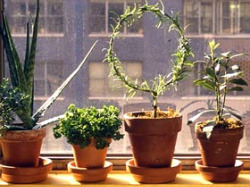
Choose a sunny, south-facing window to overwinter your herbs so they get the most light in winter.
There's nothing like the taste of fresh herbs in cooking. However, in most parts of the country, fall means the herb harvest is coming to an end. If you live in a mild winter area, you can enjoy harvesting perennial herbs that naturally overwinter outdoors, such as rosemary, lavender, oregano, and thyme, as you need them all winter long. However, in most parts of the country, perennial and biennial herbs either lose their leaves in winter or just aren't hardy enough to survive at all.
You certainly can dry and freeze herb leaves for winter use, but if you crave the taste of fresh herbs in winter, bring some of these perennial herb plants indoors. Whether they were growing outdoors in the garden or in pots, you can extend the fresh herb picking season by months by bringing the plants in when frost threatens. This technique works best for perennial and biennial herbs, such as chives, mint, oregano, thyme, parsley, and rosemary. Annual herbs, such as basil, tend to tire after a few weeks indoors. Annual herbs are best started from seed indoors under grow lights and grown as new plants for a winter harvest.
Here are the steps to bringing your perennial herb garden indoors.
Who says overwintering herbs can't be displayed in an attractive fashion?
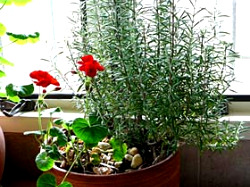
Rosemary can be overwintered indoors if given plenty of humidity and light.
  1. Select the healthiest herb plants in the garden. Don't necessarily select the largest plants. The digging and transplanting process will destroy many roots. Small to medium-sized plants will survive better.
  2. Check plants for any signs of insect activity and spray accordingly with an organic product, such as insecticidal soap, before moving them indoors.
  3. Water plants well and dig up herb plants in the garden on a cool, cloudy day. Place them in an appropriately-sized pot.
  4. Place these newly transplanted herb plants in a shady spot to adjust to the transplanting for 1 to 2 weeks. Keep them protected from winds and cold temperatures.
  5. Move container herbs that have been growing in full sun outdoors all summer into the shade at the same time. The lower indoor light conditions will be a shock to most plants, so acclimate them to the indoor environment by growing them in the shade outdoors for a few weeks.
  6. Before a frost, bring all the herb plants indoors and place them in a sunny, south-facing window.
  7. Check for any insects that have hitched a ride indoors on your plants.
  8. Water sparingly and don't fertilize.
  9. Most herbs will grow slowly, or not at all, indoors in winter. Harvest what you need, but leave some leaves for the plant to survive. You'll see your plants rebound come late winter when the stronger light levels and longer days return. The exception is parsley. This biennial herb will survive the winter only to send up a flower stalk in spring and then die. Pick all the parsley you want and compost the plant when you're done.
  10. Rosemary has special needs to survive. It likes cool temperatures (50- to 60-degree F), high humidity, and barely moist soil in winter. Keep the humidity high by misting often, and place the pot on a pebble tray filled with water. Water the pot just enough to keep the soil from drying out.
  11. Come spring, once all danger of frost has passed, move your perennial herb plants back outside. Repot them into pots with fresh potting soil, or transplant them into the garden. They will bounce back and start putting on new growth in no time.

Labels: , , , , , , , ,

Tulipano: August 4, 2011

COOKING FROM MY GARDEN

One of our jalapeno peppers
Although plants are my passion and my profession...I'm also an avid follower of all things food.  My DVR Que is loaded with programs like No Reservations, Check Please, Avec Eric and so on.  I also drive my family nuts because food is all I can talk about...I'm constantly asking them what they want for dinner right after we finish breakfast.  I know, it's annoying.

But being a planner I want to make certain I have everything on hand to prepare a delish home cooked meal efficiently without having to run to the store because I overlooked an ingredient.  What has really been nice as of late is the abundant crop of vegetables sprouting up in our garden. 

It provides us with inexpensive healthy organic options that taste ten times better than you can get at any store, or any farmers market for that matter.  It also allows me the opportunity to flex my creative skills.  My meal plan is more reliant on what I see when I walk out into the garden at night and less on a shopping list.

It is amazing what you can come up with if you say to yourself, "I'm limiting myself to what is in the garden and what is in my pantry and that's it."  I've wowed my family with tomato, basil and mozzarella pizza on the grill (thanks to my husband for the grilling part), zucchini, red pepper and spinach frittata and a surprise hit...cucumber, quinoa and wild rice salad.

Tonight I'm going to experiment with my favorite medium for vegetables, risotto.  I make a mean risotto (anyone can, it is mind-numbingly simple), but tonight I'm going to try zucchini, feta with a hint of basil.  We'll see.

What makes this all possible is that we have surrendered our largest perennial bed to a raised bed vegetable garden.  It is the single most exciting fulfilling thing we have done in our yard.  When it is too hot to piddle around in the flower beds, you can harvest the actual fruits of your labor. 

It is fairly simple to get started...you just need an area with good soil and lots of sun.  Here are a list of plants you can incorporate into your existing beds if you want to put your toe in the vegetable gardening water.

DONNA's RECOMMENDATIONS
Tomatoes - one grape variety and one slicing variety
Peppers - one Jalapeno, one green bell and one red bell
Zucchini - you need some space, but you get not only the zucchini but the blossoms which are great battered and fried
Cucumber - all you need is a trellis and harvesting is a breeze
Bush Beans - we plant four plants and it yields enough all summer for my family

Labels: , , , , , , , ,