Tulipano: March 4, 2014

Dreaming of Spring

As I sit at my desk looking out on a snowy wonderland, sun dancing off icicles still clutching to our gutter, I wonder what spring will bring.

You see I am one of those people that covet winter.  I love how quiet and graceful snow makes everything seem.  I relish that the world feels more peaceful and still. 

This winter has been long and cold and even in my household we are getting tired of clearing off yet another snowfall from our drive and walks.

Although I love the serenity winter brings I am now dreaming of crocus, thawing lakes and streams, and even what varieties of vegetables will grace my little garden.  I am looking forward to a display of spring bulbs which should do nicely given the insulation of their cozy snow blanket.  My husband is ready to break out the smoker and start up the grill. And my poor child told me yesterday, "mommy, I know you love winter, but I don't.  I am ready for it to be warm."

This winter has been record breaking and truly epic in nature and yes, it is time for it to pass, but am curious to see what this winter's legacy will be come spring.  

Labels: , , , , , , ,

Tulipano: November 7, 2012

Post Election

There are a lot of opinions floating around today post election on facebook, twitter, newspapers, bus stops, water coolers and possibly watering holes. 

I for one like to keep my opinions to myself unless I am talking to those who I know share my views or more importantly, can discuss the issues without becoming defensive or belligerent.  I am so grateful for the right to vote, the freedom to speak, but this year have found the politics almost unbearable...on both sides.

So to calm my throbbing head I am going to focus on the many tasks at hand here at our little landscape company, ILT Vignocchi...

People might find it hard to believe that there is so much to do November 7th in the landscape industry but there is...here is my short list...

Winter containers:  We design, build and install over 50 winter green displays annually.  That doesn't include the tens of thousands of square feet of evergreen boughs we will install.  Each winter green display is unique in its design.  It takes seven of us five days to complete them so they are ready to be installed the week of Thanksgiving.  The best part...it smells like Christmas in the shop!

Bulbs:  Getting tulip, daffodil, and other spring blooming bulbs installed prior to the ground freezing is a a chore in itself.  Most of our seasonal staff is ready to hang up their shovels by Thanksgiving (and who can blame them)!  This year we will go from Winter container and bough installation right into getting bulbs in the ground.  Each year I think to myself, "why didn't I think to wear just ONE more layer of clothing.  It is so cold out here!"

Snow removal:  It always amazes me that one day our trucks have no plows on them and seemingly the next...shizam!  They all have plows.  Most of it can be attributed to our wonderful shop manager Ricardo and his assistant Brian.  We are so blessed to have these guys.  We also maintain a 500 acre office park plus several other HOA's.  The planning and coordination of these efforts is paramount in making certain everything runs smoothly when snow starts falling.

As I said, this is my short list.  And the list has many contributors that make it a shared responsibility...but I'll leave that for my Thanksgiving blog!!

Labels: , , , , , , , , , , , , ,

Tulipano: October 22, 2012

Overwintering herbs


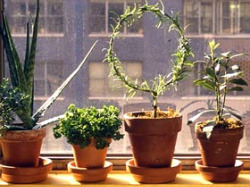
Choose a sunny, south-facing window to overwinter your herbs so they get the most light in winter.
There's nothing like the taste of fresh herbs in cooking. However, in most parts of the country, fall means the herb harvest is coming to an end. If you live in a mild winter area, you can enjoy harvesting perennial herbs that naturally overwinter outdoors, such as rosemary, lavender, oregano, and thyme, as you need them all winter long. However, in most parts of the country, perennial and biennial herbs either lose their leaves in winter or just aren't hardy enough to survive at all.
You certainly can dry and freeze herb leaves for winter use, but if you crave the taste of fresh herbs in winter, bring some of these perennial herb plants indoors. Whether they were growing outdoors in the garden or in pots, you can extend the fresh herb picking season by months by bringing the plants in when frost threatens. This technique works best for perennial and biennial herbs, such as chives, mint, oregano, thyme, parsley, and rosemary. Annual herbs, such as basil, tend to tire after a few weeks indoors. Annual herbs are best started from seed indoors under grow lights and grown as new plants for a winter harvest.
Here are the steps to bringing your perennial herb garden indoors.
Who says overwintering herbs can't be displayed in an attractive fashion?
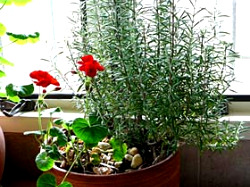
Rosemary can be overwintered indoors if given plenty of humidity and light.
  1. Select the healthiest herb plants in the garden. Don't necessarily select the largest plants. The digging and transplanting process will destroy many roots. Small to medium-sized plants will survive better.
  2. Check plants for any signs of insect activity and spray accordingly with an organic product, such as insecticidal soap, before moving them indoors.
  3. Water plants well and dig up herb plants in the garden on a cool, cloudy day. Place them in an appropriately-sized pot.
  4. Place these newly transplanted herb plants in a shady spot to adjust to the transplanting for 1 to 2 weeks. Keep them protected from winds and cold temperatures.
  5. Move container herbs that have been growing in full sun outdoors all summer into the shade at the same time. The lower indoor light conditions will be a shock to most plants, so acclimate them to the indoor environment by growing them in the shade outdoors for a few weeks.
  6. Before a frost, bring all the herb plants indoors and place them in a sunny, south-facing window.
  7. Check for any insects that have hitched a ride indoors on your plants.
  8. Water sparingly and don't fertilize.
  9. Most herbs will grow slowly, or not at all, indoors in winter. Harvest what you need, but leave some leaves for the plant to survive. You'll see your plants rebound come late winter when the stronger light levels and longer days return. The exception is parsley. This biennial herb will survive the winter only to send up a flower stalk in spring and then die. Pick all the parsley you want and compost the plant when you're done.
  10. Rosemary has special needs to survive. It likes cool temperatures (50- to 60-degree F), high humidity, and barely moist soil in winter. Keep the humidity high by misting often, and place the pot on a pebble tray filled with water. Water the pot just enough to keep the soil from drying out.
  11. Come spring, once all danger of frost has passed, move your perennial herb plants back outside. Repot them into pots with fresh potting soil, or transplant them into the garden. They will bounce back and start putting on new growth in no time.

Labels: , , , , , , , ,

Tulipano: July 25, 2012

When you forget to water your Hanging Basket

Oh, it’s happened to all of us. You come home from work to find your hanging baskets sadly wilting, seemlingly haning on for dear life. It’s easily done when containers are full to bursting point with lush summer annuals and you weren’t there to water them just when they needed it.

A quick drink is often all it takes to restore plants, but if the compost is very dry, water tends to "run off," so give small amounts and let each dose soak in before repeating the process. It also helps to spray wilting plants over with water, as a quick reviver. They’ll usually be back to normal the following morning.

But more drastic treatment is called for when a hanging basket has dried out so badly that the soil shrinks away from the sides of the container and the plants are almost on their last legs. The best remedy in cases like this is to lift the basket down, move it into the shade, and stand it in a bowl of water for five or six hours – overnight if it’s easier – while the compost re-hydrates thoroughly. But those plants will inevitably have suffered some damage.

When soil turns bone-dry it shrinks, stripping away a lot of tiny root hairs; since those are the ones that take up water, affected plants need intensive care while they recover. The trick is to reduce the leafy area of the plant by about a third, so it doesn’t lose as much moisture from transpiration as usual – simply prune any stems that are clearly past saving plus any that will tidy up the shape of the plant.

That done, treat your plant to a few days of light regular watering – still in the shade – while they replace lost roots, then give them a foliar feed. (Use liquid seaweed extract or one of the foliar feeds from a garden center; since the nutrients are taken in through the leaves, the plant still benefits even if the roots are a tad frail).

After two or three weeks an affected basket will look nearly as good as new. But you’ll need to take special care over deadheading from then on to prevent plants running to seed prematurely – it’s their natural reaction to a sudden drought, since they are trying to reproduce themselves before they die.

Labels: , , , , , ,

Tulipano: July 23, 2012

Chinch Bugs

The recent prevalence of chinch bugs in the Chicagoland area prompts me to share more information about this insect and its effects.

The drought has created conditions conducive to the appearance of chinch bug damage in turf. Chinch bugs are typically not much of a turf problem in Illinois, being more of a pest problem in the Great Plains region.

One reason chinch bug doesn't typically thrive in our region is that it is attacked by a naturally occurring fungal pathogen, Beauvaria bassiana. This causes all stages (eggs, nymphs, and adults) to be killed and covered with fine white fungal strands.  Most fungi do better under cool, moist conditions. In Illinois, we typically get enough rainfall throughout the season that the fungus controls the chinch bugs for us.  With the recent drought conditions and higher than normal temperatures, this naturally occurring deterrent isn't working.

Another reason chinch bugs attack turf grasses is the abundance of nitrogen from fertilizer applications. Chinch bugs,like many insects, reproduce more on plants containing high levels of nitrogen.

Being cold-blooded animals, chinch bugs also grow faster and reproduce more at higher temperatures, particularly those in the 80 degree Fahrenheit range.  Think about how many days we have had over 80 degrees lately!

How to identify it?  Chinch bug damage is usually first detected when irregular patches of turf begin to turn yellow then straw colored. The straw colored areas may be completely dead. These patches continue to become larger in spite of watering.

Feeding by chinch bugs blocks the water and food conducting vessels of grass stems. By blocking the water, the leaves wither as in drought and the manufactured food doesn't get to the roots. The result is plant death.

Our concern right now is that many municipalities have instituted watering bans, resulting in dormant areas of turf in lawns that are not getting enough water.  As summer progresses there may be areas of lawn that are infested with chinch bugs that might be perceived as just dormant grass.

Our crew leaders and superintendents will be on the look out for areas of concern and performing tests to locate potential infestations, but be on the look out yourself.  Are straw like areas "growing?"  Are they staying brown even after diligent watering?  If either of these questions are yes, contact your landscape professional immediately.

Last year I lost 70,000 sf of turf in a month due to the severity of a chinch bug infestation that went unnoticed.  I'm very sensitive to making certain that does not happen again.

Labels: , , , , , , , ,

Tulipano: August 4, 2011

COOKING FROM MY GARDEN

One of our jalapeno peppers
Although plants are my passion and my profession...I'm also an avid follower of all things food.  My DVR Que is loaded with programs like No Reservations, Check Please, Avec Eric and so on.  I also drive my family nuts because food is all I can talk about...I'm constantly asking them what they want for dinner right after we finish breakfast.  I know, it's annoying.

But being a planner I want to make certain I have everything on hand to prepare a delish home cooked meal efficiently without having to run to the store because I overlooked an ingredient.  What has really been nice as of late is the abundant crop of vegetables sprouting up in our garden. 

It provides us with inexpensive healthy organic options that taste ten times better than you can get at any store, or any farmers market for that matter.  It also allows me the opportunity to flex my creative skills.  My meal plan is more reliant on what I see when I walk out into the garden at night and less on a shopping list.

It is amazing what you can come up with if you say to yourself, "I'm limiting myself to what is in the garden and what is in my pantry and that's it."  I've wowed my family with tomato, basil and mozzarella pizza on the grill (thanks to my husband for the grilling part), zucchini, red pepper and spinach frittata and a surprise hit...cucumber, quinoa and wild rice salad.

Tonight I'm going to experiment with my favorite medium for vegetables, risotto.  I make a mean risotto (anyone can, it is mind-numbingly simple), but tonight I'm going to try zucchini, feta with a hint of basil.  We'll see.

What makes this all possible is that we have surrendered our largest perennial bed to a raised bed vegetable garden.  It is the single most exciting fulfilling thing we have done in our yard.  When it is too hot to piddle around in the flower beds, you can harvest the actual fruits of your labor. 

It is fairly simple to get started...you just need an area with good soil and lots of sun.  Here are a list of plants you can incorporate into your existing beds if you want to put your toe in the vegetable gardening water.

DONNA's RECOMMENDATIONS
Tomatoes - one grape variety and one slicing variety
Peppers - one Jalapeno, one green bell and one red bell
Zucchini - you need some space, but you get not only the zucchini but the blossoms which are great battered and fried
Cucumber - all you need is a trellis and harvesting is a breeze
Bush Beans - we plant four plants and it yields enough all summer for my family

Labels: , , , , , , , ,

Tulipano: January 5, 2010

AFTER HOLIDAY THOUGHTS

On this freezing afternoon just three days into the new year, I'm settling in to the fact that the holidays are over. I have safety tucked my holiday decorations into the basement where they await next year's festivities and I'm left with the post holiday blahs.

I'm sure a lot of you can identify with the feeling I'm having...it's like your heart and mind have been filled with the spirit of the season as well as all the hustle and bustle that goes with it and then it's January 1st and someone seemingly flipped the switch to off. People aren't even wishing you "happies" or "healthies" at every turn, which means life has gone back to normal.

Pondering this, I peer out the window into our sleeping garden covered with a cozy blanket of snow. There I see our raised vegetable beds. My husband is already fervently planning his crops and eventual harvest, Burpee catalog in hand. My baby Magnolia has buds that are preludes to a gorgeous spring. And my favorite part right now...a winter green arrangement my husband made for me. It was made from leftover clippings and berries, but I think it is so beautiful. A little taste of the season still hanging out on our deck.

So I'll gaze out the window at my little bit of the holidays to remind me of the spirit I so dearly covet and wait for my next favorite event ...the first crocus that peeks through a late March snow.

Labels: , , , , , ,